Sociology, Ph.D. Candidate
University of Southern California
NICOLAS GUTIERREZ III
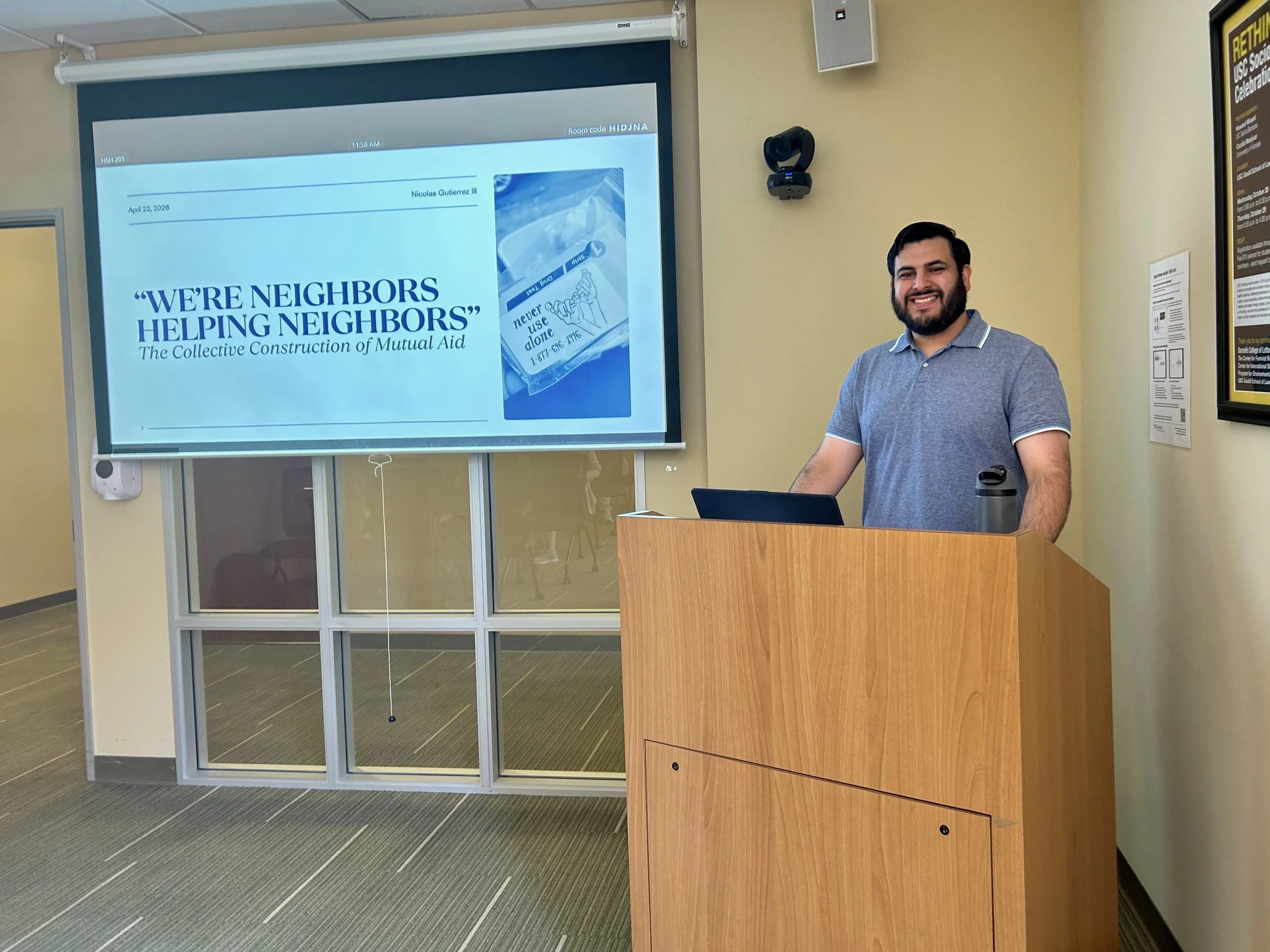
Nicolas Gutierrez III is a Ph.D. candidate in the Department of Sociology at the University of Southern California and a Graduate Research Assistant in the Captive Money Lab. He is also a USC Provost’s Fellow and USC Sociology W.E.B. DuBois & Ida B. Wells-Barnett Graduate Scholar. Nicolas earned an M.S. in Criminal Justice and Criminology from San Diego State University and a B.A. in Criminology, Law and Society from the University of California, Irvine.
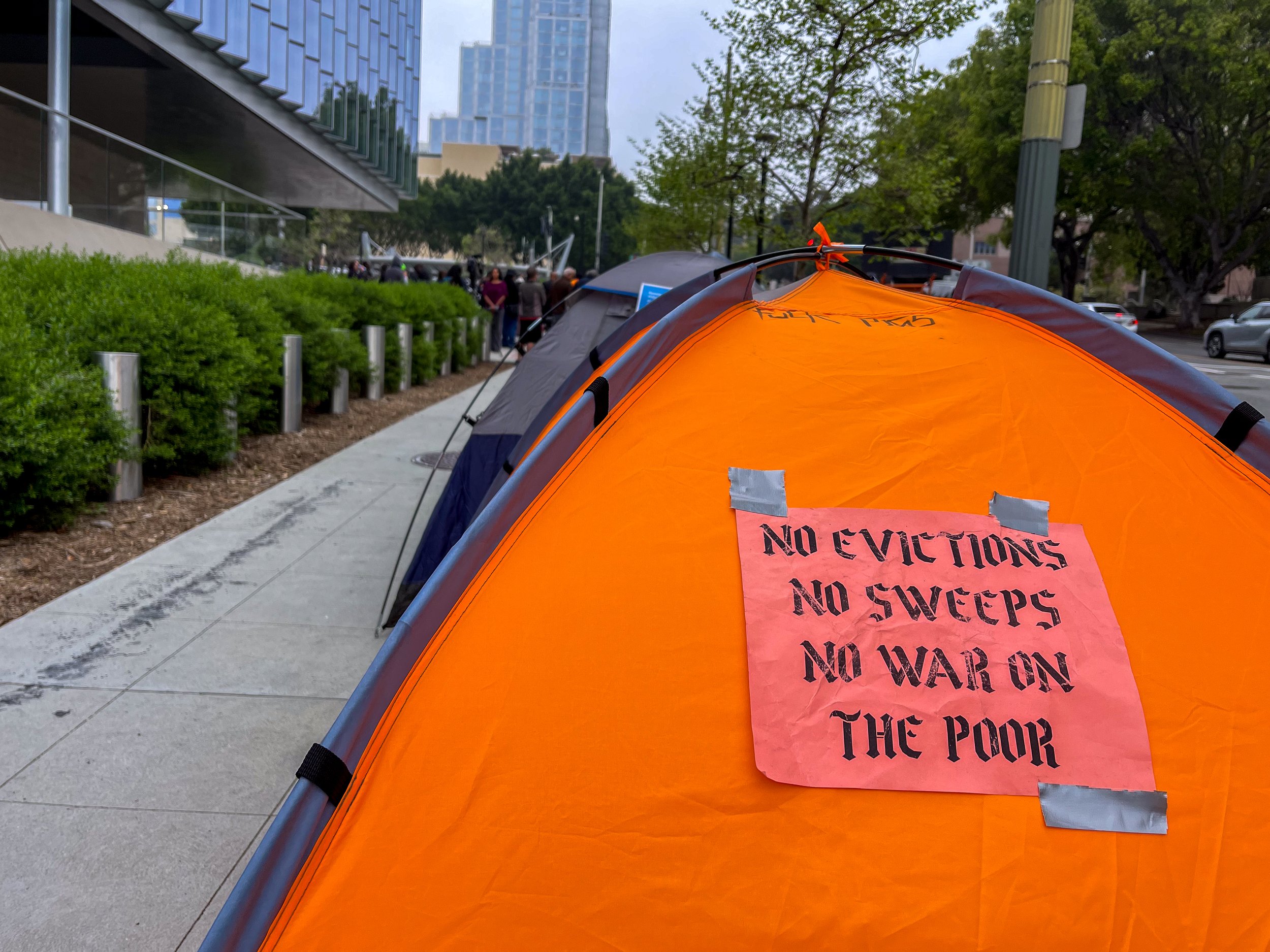
His research focuses on the intersection of unsheltered homelessness, criminalization, and mutual aid in Los Angeles, CA. Nicolas has published in Punishment & Society, International Journal on Homelessness, Public Integrity, Scholars Strategy Network, and USC ERI Blog. His research has been featured in the Voice of San Diego,CBS 8, NBC 7, inewsource, and Televisa Californias.
Nicolas has previously been a USC Equity Research Institute Graduate Community-Engaged Research Fellow, CSU Sally Casanova Scholar, Public Administration Theory Network Fellow, and UW-Madison Institute for Research on Poverty’s Professional Development Trainee. He was born and raised in West Adams, where he continues to live and advocate for housing and mobility justice. As a lifelong Angeleno, he loves his city, acknowledges its flaws, and dedicates his research career to advancing his vision of Los Angeles as a truly “just city” for all. In his free time, Nicolas enjoys watching Dodgers games and eating his way through LA.
MY RESEARCH

-
As many U.S. cities face year-over-year growth in homeless populations and a continuous dearth of affordable housing, municipalities like Los Angeles increasingly “manage” homelessness through punitive systems of criminalization, policing, and invisibilization. While scholars have documented the punishment regime inflicted on unhoused people, less research has focused on the private citizens, often organized as mutual aid groups, who intervene to counteract—and help encampment residents survive—this regime. Drawing on in-depth interviews with mutual aid helpers and encampment residents in Los Angeles (n = 24), we examine how some private citizens work to redress the harms of displacive, destructive, and sometimes deadly encampment sweeps while supporting the basic needs of unsheltered Angelenos. These helping efforts are frequently met with arrests, citations, immigration consequences, restrictions on movement, and threats of further punitive action. This article also shows how helpers assess the legal, physical, and psychosocial consequences of these repressive measures when deciding whether and how to continue their mutual aid work. Through risk mitigation strategies, helpers—individually and collectively—learn to diffuse, divert, and deflect risk and thus overcome the City's attempted repression. We conclude with a call to dismantle the expanding punishment regime that now, through the criminalization of helping, targets those who support unhoused communities.
-
On June 26, 2025, the U.S. House of Representatives passed H.R. 875, the “Protect Our Communities From DUIs Act.” While framed as a key tool for public safety, the bill could be one of the most far-reaching expansions of deportation grounds for our immigrant communities in recent history. If enacted, the bill would make driving while intoxicated or impaired a deportable and inadmissible offense, granting DHS/ICE expanded authority in an ongoing push to deport as many people as possible. Like the Laken Riley Act, H.R. 875 shows how public safety rhetoric is used to deepen the ties between the criminal legal system and immigration enforcement.
-
Under what conditions will the public accept homeless-serving housing and social service facilities in their neighborhood? In this paper, we answer this question through a basic descriptive statistical analysis of a brief survey (respondent n=251) and a thematic analysis of seven focus groups with residents of San Diego, California (participant n=34). We find that although residents were not categorically opposed to such facilities, their support was contingent on a particular approach to addressing homelessness, often rooted in misperceptions of the causes of homelessness. Participants classified people experiencing homelessness (PEH) into “deserving” and “undeserving” groups based on these perceptions. Attitudes towards homeless-serving facilities were also shaped by a belief that what is needed most are services such as substance abuse treatment, mental health services, or job training; they focused less on the need to house people who are currently unsheltered. Study participants also took a paternalistic approach to policy design, focusing on rules and regulations to force PEH to make “good” decisions. Participants recognized homelessness as a pressing social problem and were willing to consider homeless-serving facilities in their community. However, their attitudes and beliefs limited which facilities they would support, and under what circumstances.
-
This paper examines racialized encounters with the police from the perspectives of people experiencing homelessness in San Diego, California in 2020. By some estimates, homelessness doubled in San Diego during the first year of the COVID-19 pandemic. We conducted a survey of (n = 244) and interviews with (n = 57) homeless San Diegans during initial shelter-in-place orders, oversampling for Black respondents, whose voices are often under-represented despite high rates of homelessness nationally. Our respondents reported high rates of police contact, frequent lack of respect; overt racism, sexism, and homophobia; and a failure to offer basic services during these encounters. Centering our Black respondents’ experiences of criminalization and racism in what Clair calls “criminalized subjectivity,” we develop a conceptual framework that brings together critical theoretical perspectives on the role of race in the governance of poverty and crime. When people experiencing extreme poverty face apathy, disrespect, and discrimination from police—as our data show—the result is a reluctance to seek services and to engage with outreach when offered. This reinforces stereotypes of unhoused people as not “wanting” help or “choosing” to be homeless. We reflect on these findings and our framework for envisioning a system of public safety that supports and cares for—rather than punishes—the most vulnerable members of our society.

“Within revolutionary feminist movements, within revolutionary black liberation struggles, we must continually claim theory as necessary practice within a holistic framework of liberatory activism.”
– bell hooks